
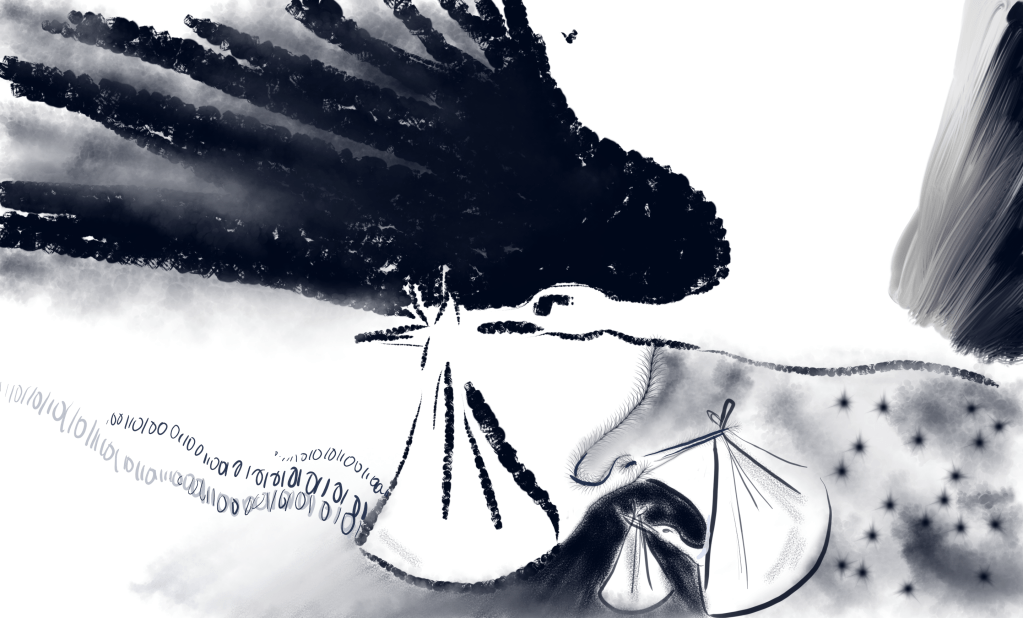
Illustration by Carcazan
AI, a life’s longing for itself
La(S)imo: Last week you planted the seed of Khalil Gibran’s words in my head: Life’s longing for itself. It took me while to realise that I could not possibly prepare for that, other than thinking.
(C)arcazan: It just came out at the right moment when we were discussing the site of meaning diaBlog… He said it about having children and his view that your children are not yours but ‘the sons and daughters of life’s longing for itself…’ and I wondered.. the AI art debate and concern are not just about survival but about our ability to progress without being the authors of our own misfortune, no?
S: Humans are known to be the authors of the best and the worst of changes. The scientific history surrounding nuclear energy is a key example. At the AI/ML Media Advocacy Summit yesterday, Timnit Gebru was trying to make the point that we can drive the use of AI — that we are the ones deciding if and how it is to be used. But I do not see a cohesive “we”. “We found Asbestos to be harmful and stopped using it,” She said. But a lot of people died on the way, and by the way, it is still used, though not in the same way, or possibly, only in places where people would not know to have to protest its use. I do not see it as simple as that.
C: Exactly. I like this concept of the ‘cohesive we’ — as people, as professionals, as the human race…? It’s endless. And so many people or echelons of society are better at, or advance themselves by ‘othering’ anyway… The cohesive we… You know somebody invented AI and thought: wow, this is the height of my achievement, it’s my art form, and it’s still in its infancy…
S: Abhishek Gupta raised the anthropomorphising of AI as one of the core dangers of its public perception. As long as we relate to it as some kind of “life” form with autonomous thinking, it will be harder and harder to reach that cohesive we — we as the makers of that machine, as opposed to placing “it” in the driver’s seat. But again, isn’t the creation of an artificial intelligence at the heart of human existence? The wish to emulate God, the call of infinity. Mary Shelley’s Frankenstein echo of the human soul. I liked one idea I heard yesterday — asking to destroy the existing databases used by AI art generators and create new ones based on copyright regulations. This kind of pragmatic thinking returns AI to the place where it belongs: a world of software, where bugs are to be fixed.
C: We anthropomorphise household objects because humans are social and find comfort in relationships and connections (well, most do!). My Grandfather nicknamed his washing machine Katarina. If my mobile phone breaks, I say it has ‘died’ — those who believe God created (wo)man in his own image pretty much get that we probably want to do the same, some for control reasons or the need to conquer in order to protect themselves, some for the love or need of giving life and imputing a connection with a non-human in a way which actually increases our own capacity to empathise and care. So the AI debate is in essence about which side of the divide AI art will fall upon or should sit within — at the moment it’s all very LimeWire/Napster (for anyone old/young enough to remember this!). The AI/ML UK Panel had a really interesting explanation about the legal IP/copyright loopholes and landscape..
S: We have a complex, manifold challenge. We need regulations; public awareness in the form of education (Ethics and civil rights); self-protection (being a passive inhabitant of the Internet will no longer do); and we need to convince AI engine makers to accept to retrain their software every time it is needed (new copyright laws, for example) and therefore, to invest in having that as part of the standard software lifecycle. I guess this is where a heterogeneous we is going to be a real asset. Is history teaching us the power of collaboration?
C: Well, I think history has shown, especially in larger countries of significant power who thrive on corporate advancement, that sometimes corporations lobby for laws to be changed to their advantage.. yet I feel that the world at the moment is in an unprecedented culmination of events, a vortex spiralling to the core of the problem: ourselves fighting for our souls and our souls fighting for themselves. With LimeWire (and Napster), legal challenge through copyright tenet eventuated in their end, the protection of artists’ rights in that instance, pretty much won. I understand that LimeWire may be wanting to resurface on the NFT market, but we know NFTs have way less regulation and are still gel-like in its rights-based and protections foundations. We long to invent, leave our mark and be remembered, and we’ve now invented something that with an appropriate nudge can invent, leave its mark and be remembered and go on doing so using the blood of others’ work.. If history could teach us collaboration, there would be no wars. Times may change but human nature doesn’t really.. hence history repeats itself but in different permutations. A panellist at yesterday’s AI/ML event suggested that artists need to have a conversation with AI rather than fear it – I don’t think artists have ever been technophobes, we are just against having our work swiped by someone or something else. I don’t recall AI or its architects ever seeking consent from me or any of the artistic bodies to scrape our data or use our work… that’s not how you start a conversation..
S: I am allergic to the invite to “have a conversation with AI”. It patronises the artists, as if they touch AI with a stick as if relating to a mysterious creature. It is not a “creature”. It is a piece of software. Artists and any user, for that matter, are to familiarise themselves with new concepts. And it is of the technical community to find the words to make that world understandable by non-technicians. Maybe we should rethink of our duty to be generous with each other with our knowledge. I read an article few days ago, about how the virtual community could benefit of behind-the-scenes kindness, as opposed to this urge to appear great onstage. It seems at the core of self-awareness, self-worth, and commitment to a hierarchy of collective good.
C: A quick intersperse – I heard a disturbing rumour that some art directory/commissioning bodies have been approached by commissioners wanting to hire “a promptor who is an artist”… you see how we have already been relegated? The corporate consciousness advances quicker than we can lay down the tracks of protection so the train of development doesn’t run away with (or over) us… and if one more voice suggests that AI art is just like the initial fear about photography (I don’t recall a camera swiping other painters’ works in order to take a light-based image of what is in front of it), I may query whether that’s being parroted because it actually formed part of the Stability AI defence in that class action suit brought against them in the USA… What if we all turned our social media and websites blank for a week in protest? Or with a message “gone fishing until AI is regulated – contact me direct” – or will AI have already scarped our data anyway?
S: Haha. The search for “a promptor who is an artist” sounds like a more familiar “I need a software engineer who can also write”. Believe it or not, it may not be as evil as it sounds. It’s like saying, your artist core is key to analysing the value of what a machine creates. As for the social media protest, well, have we forgotten that everything we posted belongs to the social media owner? We use social media as a service, for our own entertainment, so perhaps the true protest is doing something silent, off-stage: starting the collective design of that cohesive we… Shall we start to think of a big-picture strategy?
C: Yes. So many are doing the same — Lorenzo Ceccotti’s manifesto is just incredible, it straddles the artistic and technical nuances superbly. It’s one aspect of what is needed, but it’s important. There is also the aspect of the production: that a commissioner would ask for an artist able to use AI implies that AI is to be used for the production — how long before the commissioner defaults to AI altogether? Besides, any use of AI in the creative production requires that it is better regulated first. The context calls for a collective manifesto and strategy…
S: Sounds like we have just found our next chapter!
 About
About 