
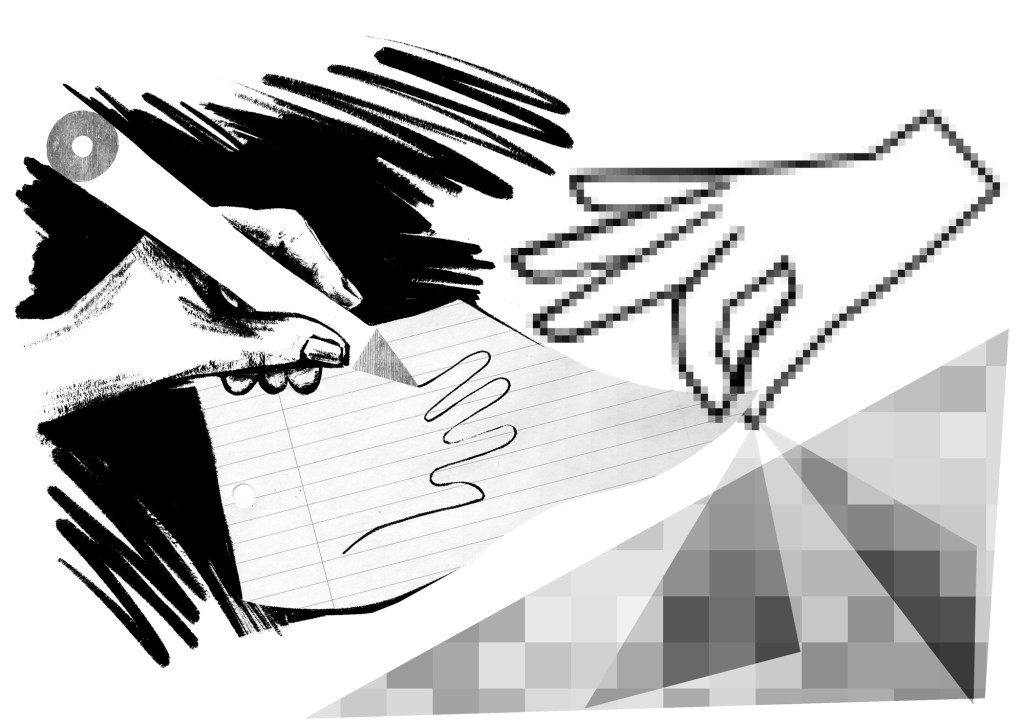
Illustration by Ginette Guiver
AI Art: Reference, Plagiarism or Original?
La(S)imo: So, we left off at the quicksands of plagiarism. AI creates new artifacts “inspired” by past and current production. References are opaque, unless we teach AI to provide all the sources, and even then, can we really call them “original”?
(C)arcazan: Well, it depends exactly what ‘inspired’ entails… If it’s using other people’s work without their consent, then that’s not inspiration…
S: Being AI, we know the answer. But again, what is the smallest replication of someone else’s work that constitutes plagiarism? And do AI art generators have any compass?
C: I think the compass should be determined by whether or not artists consent to AI drawing on (no pun intended, or maybe yes!) their work when responding to a ‘promptor’s’ command. I think the parameters must be set first by artists, then by guidelines, then by whoever programmes AI to know what its resources pool is within these parameters.
S: Well, that goes for those alive. What about the others? The artists of the past, I mean.
C: So copyright / intellectual property laws will apply to those who are dead like when a musician or someone like that dies and then maybe 70 years after their death you can use their work rights-free. Surely the priority now is to protect those who are alive and trying to work as illustrators or artists, data protection laws for example only apply to the living. But I don’t agree that AI’s product (I won’t call it artwork) is original because art is about conjuring one’s personal identity and AI has no personal identity. It has traits, but not personal or cultural identity.
S: Both dictionary and encyclopaedia speak about conscience, and expression of skill or imagination, when defining art. We can safely say that AI has no conscience. But again, definitions are normally introduced to define things that already exists — to frame them. So maybe we need a new definition of art. We cannot stop or prevent the use of the term in relation to creative production. The language evolves driven by its use — for good and bad. So we might as well think about redefining boundaries.
C: There’s redefining art by preserving a cow in formaldehyde because that was a human mind’s vision of expression (whether or not you agree with that permutation), and then there’s redefining art to permit tech giants to usurp true cultural advancement or reaffirming it. At the moment movements for regulation like UNESCO (Internet for Trust), and the AOI’s and partners to protect artists rights from AI — these are all to stop AI using artists and artworks like its own personal paintbox thus diluting and relegating what it in fact feeds on. There is already the term ‘AI art’ and that is fair enough, but it’s not original, AI does not have ‘ways of seeing’ in the way John Berger discusses, it only has ways of responding.
S: Well, AI can be given sensors, so while we certainly agree that an AI engine may not process sensorial experience the way a human would (memory, conscience), it is not true that AI does not see — in fact, through the processing of any visual input, it is actually able to “see” in ways we cannot. We can only see through eyes; AI can acquire visual material without a sensor…
C: Don’t we also see with our mind’s eye? Or see things in our dreams?
S: And it is not a static algorithm: it grows. The use of AI to respond to a prompt is just one possible application. I am not saying that we see in the same way. I am just saying we cannot acquire visual material without seeing it first. Of course, on the other hand, AI cannot do the things that our conscience does… Dreaming and all. And our work is not fully original either. But conscience is crucial, here.
C: Well, perhaps all the movements for guidelines and regulation are to build AI a conscience… So it acts conscionably. But I think we do draw on visual material from our minds and memories. Yes we look at reference material to know how many bones are in the human skeleton for example, but maybe originality also comes from expressing something or something in a way that actually nobody asked you to that means something to you..
S: Yes. Funny you say this, because I was thinking precisely this: take two identical artifacts (assuming this were possible) — one authored by AI and one by a human, neither of them knowing of each other. I, as a member of the audience, could grow to appreciate the one created by the human when learning about their intentions — like when I asked you to explain your illustration yesterday. But I may never grow to like the very same artifact created by AI, because I will always see it as void of meaning and purpose.
C: Which makes it even more painful if AI uses practising illustrators’ work without consent and then somehow it becomes famous or profitable…
S: I think Ginette’s illustration is spot on. While “drawing on” someone else’s work, AI is actually appropriating their process and practice, the journey that took them there. This is the territory of Ethics, I guess. Does the consumer get educated on this?
C: I wish you said that at the beginning! It would have been ‘chat over’ but a golden nugget nonetheless. Ethics but also legal rights and I would say spiritual jurisprudence..
S: In recent years I learnt something obvious and yet very sad: that justice and law are far from being synonyms. And that law, regulations and policies still are not enough. I know that we have a long way to go in caring about who or what dies in the making of what we buy. Will this be any different?
C: For every law that’s made, someone will break it, that’s why there are penalties and offences. And consequences also go beyond mere statutory prescription.. But if you want to talk about the environmental and questionable labour realities around cryptocurrency, AI and Big Tech, that’s a whole other conversation…! And funnily enough ‘crypto’ like ‘cache’ also means ‘to hide/hidden’… AI: an old new world order?
S: But again, we need more than just law — that’s what I meant. I think all humans should have Philosophy in their mandatory education. Too many do not know what Ethics means. And many more treat Ethics as synonym of Moral.
C: It’s hand in hand with also investing in art/creative subjects in children’s education and development, so they can relate it to and explore their ideas/interpretations and create something they can be proud of. This encourages empathy and self-reflection. AI knows what you mean when you ask it for something but can’t produce something that has meaning.
S: So, the only site where meaning is produced becomes the audience. Dangerous individualist drift… we certainly need no encouragement that all that matters is our own view. Every single service is teaching us this. Reinforcing this. How about this for the next chapter? The site of meaning in AI production?
C: The site of meaning? Tough one… Ok, let’s do it!
 About
About 